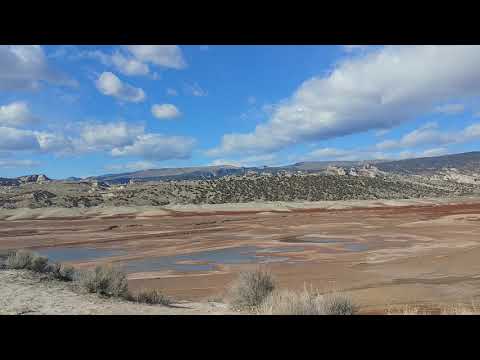
About 3.5 million people live in Utah — spread out across approximately82,000 square miles of desert, forest, alpine regions, and surprisingly, a bit of wetlands. Most of the state is desert, with very hot days and very cold nights; about 25% of Utah is temperate forest with both deciduous and coniferous trees, and less than 1% of Utah is a wetland with about 75% of those wetlands located near the Great Salt Lake. On land 10,000 feet above sea level lies the alpine region with short, hardy plants that can survive high wind speeds and extreme cold. Utah mountain peaks, on average, are the tallest in the US with an average elevation — in each of Utah’s counties — 11,222 feet higher than any other state.
CLIMATE IMPACTS
Utah has not been spared the effects of climate change.
- Warming about 2°F in the last century, climate change is diminishing the flow of water in Utah’s rivers and escalating the frequency and intensity of wildfires.
- As the state warms, less precipitation falls as snow, and more snow melts during the winter months. The Utah snowpack has been shrinking since the 1950s, shortening the season for skiing and other forms of winter tourism and recreation as well as altering the way snow melts into the Green and Colorado rivers.
- As the amount of water from the heat is diminished, the need for it, because of the heat, increases. This has many negative effects on the ecosystems and human populations depending on the rivers.
- Those rising temperatures are particularly harmful to agriculture in the state, which uses 80% of its water.
- In addition to reducing the amount of water flow available through its rivers, the heat increases the amount of water evaporating from the soil, making it harder to irrigate fields and keep livestock.
- Heat also threatens the health of cows, causing them to eat less, grow more slowly, and produce less milk.
- Higher temperatures and resulting drought are also likely to increase the severity, frequency, and extent of wildfires. As of Oct. 4, 2020, with the third driest spring in its history and extreme and exceptional drought across the state, Utah saw 294,930 acres burned. Along with burning down towns and ecosystems, wildfire smoke can reduce air quality and increase medical visits for chest pains, respiratory problems, and heart problems.
ENERGY
Coal still supplies the majority of electricity generation in Utah, providing 46% in 2023, although this is down from 75% in 2015.
- Natural gas provided 34% of electricity in 2023.
- The rest of Utah’s generation is largely from renewable energy, which accounted for 19%.
- Utah ranks 14th in the nation for solar power generating capacity and contributed 17.24% of Utah’s electricity generation in 2023.
- Utah’s five wind farms accounted for 10% of renewable generation.
- Hydropower accounted for 8%.
- Utah is one of seven states in the nation with utility-scale geothermal electric generation, ranking third in the nation behind California and Nevada.
PLANS TO ACCELERATE CLIMATE GOALS
- In 2010 the Utah House of representatives passed a resolution implying that there is a climate change conspiracy and urging the EPA to stop all carbon dioxide reduction policies and programs.
- One of the reddest states in the nation, in 2019 Utah created a long-term comprehensive plan to address climate change. At the request of the state legislature, the Kem C. Gardner Policy Institute produced the Utah Roadmap: Positive Solutions to Climate and Air Qualitywith the intention of reducing greenhouse gas emissions affecting both the local air quality and the global climate. The plan includes cutting CO2 emissions statewide 25% below 2005 levels by 2025, 50% by 2030, and 80% by 2050. It focused on a market-based approach to combat climate change, deal with transportation, infrastructure, housing options, energy efficiency, and electric vehicles. The plan gives special attention to those in Utah who live in rural areas.
- In October, 2020 more than 100 mayors (including Logan’s Mayor Daines and Salt Lake City’s Mayor Wilson), business, and academic leaders from throughout the state signed Utah’s first Climate and Clean Air Compact committing their support of the Roadmap.
- The Utah Office of Energy Development and the Utah Department of Natural Resources released a Utah Strategic Energy Plan Framework in 2023.The plan does not mention climate change, noting that the state’s energy policy requires an expansion and development of both nonrenewable and renewable sources.
- In 2024, Utah governor Spencer Cox signed bill # HB241 changing the word “renewable” to “clean” in Utah statute in order to include sources such as nuclear, geothermal and carbon capture and sequestration.
CLIMATE ACTION WITH THE FEDERAL GOVERNMENT
- The Advanced Clean Energy Storage Project, financed by the U.S. Department of Energy, will construct the nation’s largest hydrogen production and storage facility in Delta, Utah.
- Utah participated in the EPA’s Climate Pollution Reduction Grants program, receiving a grant to develop a Priority Climate Action Plan. The Utah Department of Environmental Quality released its Beehive Emission Reduction Plan in February 2024. The plan includes a GHG inventory, GHG priority measures, and a benefits analysis. Utah received $74.7 million in funding for the implementation of the plan.
- Utah received $74.7 million from the EPA to implement the Beehive Emissions Reduction Plan, which focuses on locally-driven solutions to reduce emissions, support communities, and promote clean energy. The Utah Department of Environmental Quality's page says.
- Salt Lake City also produced its own Priority Climate Action Plan under the program.
CREDIT: THE NATURAL PROGRESSIVE